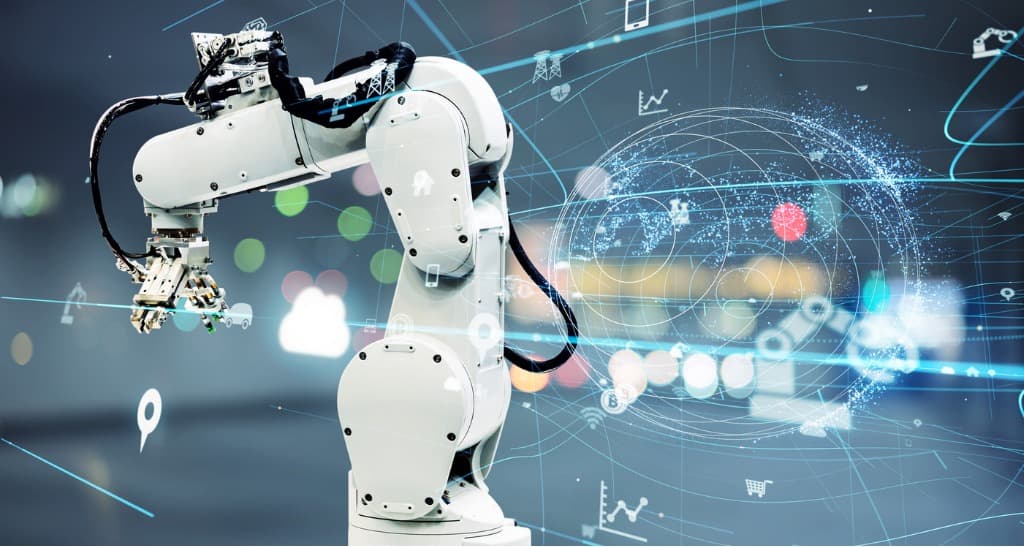
Machine learning is a sub-field of artificial intelligence and involves the ability for IT systems to learn, develop, and evolve from large data sets and without the need to follow explicit instructions. By analyzing data sets, computer systems can begin to recognize certain rules and regularities via algorithms. The goal of machine learning is to identify correlations from extremely large and complex data sets in the shortest possible time, to draw conclusions and make forecasts.
Find the right experts for your project with Brunel
Brunel can support your next machine learning project with highly qualified experts from the fields of computer science, statistics, data management, mathematics, and physics. Our experts have many years of experience in the development and programming of machine learning models and are skilled in the use of common programming languages such as R and Python. Get an overview of our experts and find out more about our range of services in the areas of employee leasing, contracts for work, and services.
Machine learning has been one of the disruptive technologies of the 21st century and will continue to impact production and business processes across more and more industries. But over time, it is expected that this new and disruptive technology will be considered a technological standard. Read on to learn about what experts currently understand about machine learning, how it works, and what possible applications there are for its use.
Overview of content
Distinction from Artificial Intelligence
Distinction from Deep Learning
How does Machine Learning work?
Areas of application of machine learning
What new professions are created by machine learning?
How Brunel can support you with your project
Distinction from Artificial Intelligence
Artificial intelligence and machine learning are highly discussed topics at present. Often both terms are used in the same context despite offering two different solutions . Artificial intelligence refers to technology that can mimic human intelligence and autonomously perform tasks that contribute to the achievement of certain goals. Machine learning, on the other hand, describes the mathematical models and algorithms needed for an IT system to learn.
Distinction from Deep Learning
An essential difference to deep learning is that machine learning lacks elements of artificial intelligence. Deep Learning is able to analyse huge amounts of unstructured data and independently generate new, previously unknown solutions. Machine learning, on the other hand, requires structured data. Although these serve the machine as a basis for decision-making for its transactions, the latter also have to be programmed beforehand, since in contrast to deep learning, the machine does not learn its own solution paths. The advantage is that machine learning is significantly faster and can be realised with simpler software and hardware components.
How does Machine Learning work?
For machine learning to succeed, an IT system must first be trained by a human with a specific data set. The IT system then uses algorithms to analyze the data set for patterns and correlations, continuing the process until the result is of high quality. Once the learning process has been completed, the IT system should be able to independently analyse and evaluate new data. In machine learning, a basic distinction is made between the following sub-areas:
- Supervised machine learning
- Unsupervised machine learning
- Semi-supervised machine learning
- Reinforcement learning
Supervised machine learning (SCL)
In supervised machine learning, the IT system learns based on a training data set where the correct answers already exist. Based on the given data set, the algorithm learns to reach the known target variable and establish rules and patterns. Then the prediction is evaluated. This process is repeated until the prediction matches the desired quality. The experience gained from each run is incorporated into the learning process again and again. If the trained model delivers the desired results, it can subsequently be applied to unknown data. The goal of supervised machine learning is to generate predictions and recommendations.
There are two types of supervised machine learning; classification and regression.
In classification, the model should assign data to specific criteria. For example, if an IT system is to automatically recognize handwritten postcodes, the handwritten numbers would be the criteria classification. These are perceived as images by the IT system, analyzed, and classified based on the digits (output) 0 to 9. E-mail providers also use classification; To automatically warn users of spam e-mails, supervised learning procedures are used to examine each e-mail for spam and then automatically classify the email into the categories of spam or not spam.
Regression, on the other hand, is used to achieve future forecasts and to identify trends. The streaming provider Netflix, for example, uses regression as a supervised learning procedure for content recommendations. Based on the interests of the user and similar users, Netflix can provide personalised recommendations.
Unsupervised machine learning
In unsupervised machine learning, the algorithm learns to recognize patterns and relationships on its own, without being given explicit target variables. Since there are no limits to unsupervised machine learning, the model recognizes patterns of all kinds and helps to find new criteria for categorizations. Compared to supervised learning, the personnel effort is somewhat lower, since unsupervised learning can also be used where the 'target' of the data analysis is not clearly defined.
There are different types of unsupervised learning:
Clustering: Finding frequency structures, patterns, and grouping the data into a few characteristic sets.
Associations: Finding rules that map the connection between data points.
Dimension reductions: Reduction of all existing variables to the most important ones.
Unsupervised learning is used in marketing, for example. Here, company-specific customer master data is grouped according to their characteristics, e.g. into 'young people with an affinity for technological toys' or 'people with middle-aged children'. Unsupervised machine learning is also used for chatbots. Chatbots learn social interactions via the questions entered by users and can even recognize insults or racist remarks on their own.
Semi-supervised machine learning (SMA)
Semi-supervised machine learning is a combination of supervised and unsupervised machine learning. Here, target variables only exist for a part of the total data set, as the collection of the target variables can be associated with high costs, such as the need to recruit experts or fix damaged workpieces. Obtaining data, on the other hand, is not a problem in this scenario: If unsupervised learning methods are used, the (few) available target variables serve as representative labels of the structures found; if supervised learning methods are used, the data without a target variable serves to make statistical accumulations easier to estimate.
An example of semi-supervised learning is the creation of a training data set for object detection in video data. Based on the assumption that directly successive images of a video stream depict the same thing and that, for example, the camera angle or the position of the objects only changes slightly, time can be saved as objects do not have to be marked manually in each image.
Reinforcement learning
Reinforcement learning, in contrast to supervised, unsupervised, and semi-supervised learning, is not based on a prior existing training data set. Instead, this is generated during the runtime of the algorithm using available information. Unlike artificial knowledge, which is learned through trial-and-error runs, reinforcement learning is modeled on the human brain.
Reinforcement learning can be used wherever the problem-solving path is complex and varied, but the desired outcome can be simulated or otherwise assessed without causing much 'damage'. Situational behaviour can also be trained well through reinforcement learning. Classic examples can be found in computer games, where the surrounding world is too complex to be fully represented over a finite data set. However, since the possible actions and the current situation can be assessed, situational feedback can be used to evaluate an action in context as 'good' or 'bad'. Similar approaches can be found in the education of children, who learn to find their way in the world through praise and criticism. In a corporate context, reinforcement learning systems can be found in direct marketing: If a recommendation system suggests relevant products to a user, it has done its job well. If no purchase is made, the system is given negative feedback so that it recommends other products next time.
Areas of application of machine learning
Healthcare: Machine learning is already being used in the healthcare sector. Similar to other industries, a large amount of data is available here that is difficult to handle manually. The diagnosis of diseases, long-term ECGs, or the evaluation of blood counts quickly pushes medical professionals to their limits. This is where machine learning comes in. From the analysis of a multitude of data and the identification of patterns and correlations, disease progression can be recognized much faster and treated earlier allowing for costs for non-targeted therapies to be saved. In essence, machine learning can complement and support the healthcare industry, for example with the early detection of disease patterns, the identification of tumours in X-ray or ultrasound images, or the creation of diagnoses based on various blood values.
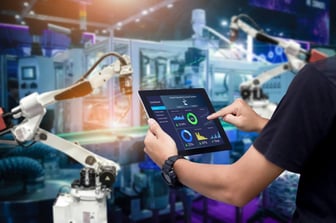
Industry 4.0: Smart manufacturing or predictive maintenance are buzzwords that are already used across industries in connection with machine learning and artificial intelligence. This refers to the optimization of production processes and predictive maintenance of machines. Algorithms can be used, for example, to detect bottlenecks in upcoming process steps before they occur, so that production does not slow down or become inefficient due to waiting times. In addition, the condition of machines can be measured by installing sensors and then algorithms can be used to detect malfunctions or a possible failure of parts at an early stage without these having any influence on the course of production.
Financial services: The use of machine learning can also bring advantages to the financial services industry where it can, for example, uncover cases of fraud or help with individual financial advice. Through the individualisation of algorithms for each user, it is possible to determine their creditworthiness based on each applicant’s situation, as opposed to using the traditional standardized scorecard system. Some major banks, such as HSBC, also use machine learning to detect illegal transactions.
Logistics: Logistics is an important economic factor and increasingly determines the success of many companies. Increasing efficiency is one of the most important goals and challenges at the same time. The use of machine learning can bring the logistics industry a great deal closer to its goals. Predictive planning in the areas of capacity management, route planning, network planning, and risk management are advantages that machine learning brings. For example, the expected arrival time of certain freight wagons can be predicted based on current traffic and goods data. This allows for quick reactions to unplanned deviations in real-time, for example by changing production prioritization because parts are delayed or by sending a change notification to the customer if the originally planned delivery date cannot be met. The use of machine learning in logistics will eventually see loads able to organize their own transport in the future. This is made possible by the increasing networking of logistics processes between customers, service providers, and cooperation partners.
Energy sector: Machine learning plays an important role in the energy sector, especially in the maintenance of power plants. This is exemplified, for example, by sensors on a wind turbine that sound an alarm in the event of certain irregularities and lead to a shutdown. The decentralisation of energy supply also requires increasingly complex forecasts, e.g. on consumption and the weather conditions for electricity generation. Here, too, machine learning has its place in ensuring a balance between energy production and consumption. Machine learning is particularly important for optimising energy demand, for example by continuously adjusting the heating capacity of large buildings to the weather conditions.
IT industry: The IT sector relies extensively on machine learning, although the boundary to deep learning is often blurred here. Programs for image and voice recognition are more closely associated with machine learning. Many digital assistants are based on this principle and use a wide range of previously fed structured data. Perhaps the most important area of application, however, is IT security. Machine learning can improve methods and tools to increase the security of various systems.
A well-known example of this is spam filters in email programs. Other IT security systems based on machine learning are anti-phishing and anti-fraud. Because cyberattacks are becoming more and more sophisticated and customer demands are becoming more and more demanding, deep learning or artificial intelligence is becoming more and more important in the IT industry and will eventually replace machine learning, at least in part.
Automotive industry: In the automotive industry, machine learning is mainly used in two areas, namely in vehicle production and in the form of various assistance systems in the finished car. Vehicle construction is based on a complex system of transport and assembly processes that are increasingly automated. This is made possible primarily by machine learning. Based on structured algorithms, fully automated production plants obtain the raw material, assemble the cars and feed them to the further assembly steps, some of which still have to be done by hand.
In the vehicle itself, various assistance systems are based on machine learning. However, a distinction must be made here: While machine learning is sufficient for rain sensors and parking assistants, autonomous driving is based on artificial intelligence. Due to the abundance of unexpected events in road traffic, machine learning would reach its limits here.
What new professions are created by machine learning?
Machine learning is creating new professions and changing existing disciplines. If this topic would have been an exotic speciality 20 years ago, today no mechanical or electrical engineering student can avoid it. A new profession is, for example, the machine learning engineer, who is fully specialised in the research, development and implementation of machine learning structures. However, since machine learning is only possible through the processing of large amounts of data, new jobs such as data scientist or data engineer are also gaining enormous importance. The professions of service technician, electrical engineer and automation technician are also changing due to the establishment of machine learning.
How Brunel can support you with your project
Your machine learning project will be in the best hands with us. Our expert software developers have experience and knowledge from working across numerous machine learning projects and therefore have the know-how of all the relevant tools and skills your business will require.
To find the most suitable candidates for you, we use a proactive and forward-looking approach as well as our global network of technical and IT specialists. Our talent scouts and account managers use a mixture of data analysis, market research, and various channels and networks to find suitable candidates. This enables us to match individual requirements with suitable profiles.
Get an insight into the knowledge of our experts and find out more about our recruiting expertise.