
Augmented Reality (AR) represents a technically innovative concept of how visuals are seen by the user. The principle behind AR is the insertion of computer-generated information into the same view the user has of the perceived reality. One of the best-known examples of augmented reality is during the broadcasting of sports events. For example, someone watching a free kick during a football match on a TV screen will see the live broadcast as well as a superimposed visual to show the distance to the goal. The term augmented reality is by definition not limited to visual impressions, but is often only used for this in practical use.
Overview of content
How does Augmented Reality work?
Where is Augmented Reality used?
What is the significance of Augmented Reality for digitization?
How can companies use augmented reality for digitization?
What does the future hold for Augmented Reality?
What new professions are emerging through Augmented Reality?
How does Augmented Reality work?
Augmented reality is technically based on a mixture of real images and computer animation. In professional circles, this is referred to as "mixed reality" and requires extensive technical equipment. On the hardware side, powerful computers and sensors, such as cameras, GPS transmitters, and microphones are needed. In addition, the interfaces must be coordinated in such a way that the information reaches the end user with the required precision.
On the software side, programs are needed that evaluate and analyze the incoming data in a millisecond and convert it into the appropriate user signals. For the football example mentioned, this means the referee whistles a free kick and within the time the shooter is positioned in front of the ball, GPS sensors measure the distance to the goal based on the live images. Even before the free kick is taken, this information is integrated into the viewer's televised image.
Where is Augmented Reality used?
Football broadcasting is just one example of AR. Modern cars also rely on this technology by projecting useful information (e.g. speed, navigation) onto the windscreen. As do many video games; Pokémon Go is also a good example of the use of augmented reality. Players look at the real environment on their mobile phone display and see imaginary creatures superimposed on it.
Other possible applications are AR glasses in the military, where important parameters are superimposed on the soldier's field of vision. AR is also used in trade fairs to help sell products, facilities, etc. as these can be presented much more vividly in a virtual way.
Digital and mobile phone cameras also function according to this principle. If desired, users can integrate elements into a photo that are not actually there. AR is also gaining ground in various learning tools as well as in the art and architecture sectors.
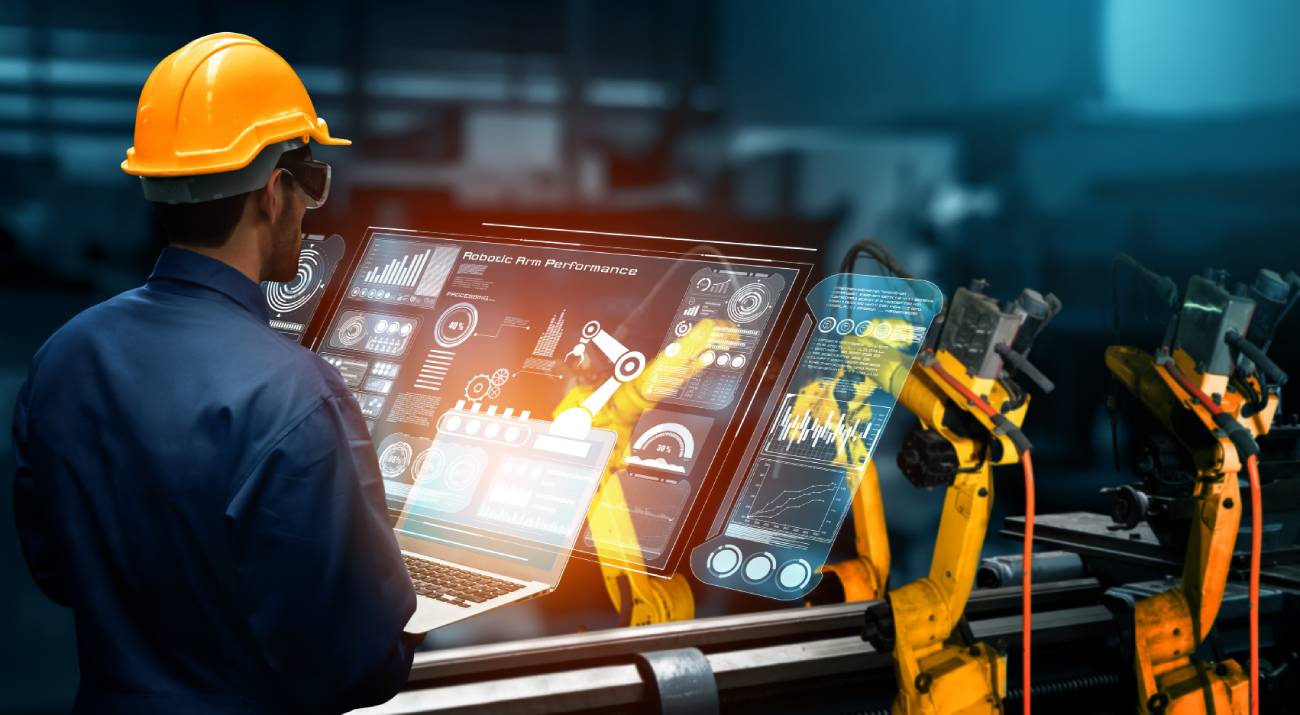
In addition, superimposed information is increasingly supporting doctors during surgical interventions or imaging procedures, and technicians are also benefiting from this innovation during assembly or maintenance work.
An example of auditory AR is the announcement in trams or buses. Here, a GPS sensor registers the current location and a computer-generated voice provides information about the next stop and gives information about connection options.
What is the significance of augmented reality for digitisation?
Augmented reality is not only very important for digitization, it’s part of digitalization itself. A study by the Fraunhofer Institute for Manufacturing Engineering and Automation (IPA) states that AR is what makes digitization tangible in the first place in many areas and can be considered an essential digitization solution. The more information that can be provided without additional end devices, the more advanced digitization is. Taking a car as an example; while a paper road map and an integrated navigation system were needed in the past, today the windscreen is sufficient thanks to AR. In this respect, augmented reality is one of the main drivers of digitization.
How can companies use augmented reality for digitisation?
An advantage of augmented reality for companies is the fact that - unlike virtual reality - it does not necessarily require glasses. This makes the concept much more practical. Companies can also use augmented reality for digitization in a variety of ways and decisively simplify all work processes and services for both customers and employees.
The list of possibilities for the use of AR within companies is endless, but a couple of examples include: A car manufacturer can provide its customers with a highly digitalized vehicle through AR; the television experience for viewers of sporting events is more informative than ever; service technicians have valuable information at their disposal during assembly work through AR devices (e.g. tablets), which would otherwise take a lot of time to determine.
What does the future hold for Augmented Reality?
Augmented reality will play an increasing role in numerous segments of the economy, as well as in everyday life. In the future, it will be primarily a matter of further optimizing the AR capability of end devices, such as tablets and smartphones, and establishing possibilities for use that are still experimental today. Although augmented reality does not require glasses, there are efforts to make video games such as Pokémon Go even more realistic through the use of AR glasses. Above all, however, the goal is to gradually expand the range of applications of AR and to ensure that users are provided with additional information to an unprecedented extent and that various everyday objects are designed to be AR-compatible.
What new professions are emerging through augmented reality?
Augmented reality is changing existing professions and creating new fields of activity. Jobs in electrical engineering, sensor technology, and computer science won’t be able to avoid this field in the future. The same applies to game programmers, graphic designers, or mechanical engineers who will have to integrate AR into their products/applications. The principle of AR is based on large amounts of data and the finest sensor and processor technology. That's why AR has seen the development of new professional fields such as Big Data Scientists, Algorithm Developers and AI Specialists.