
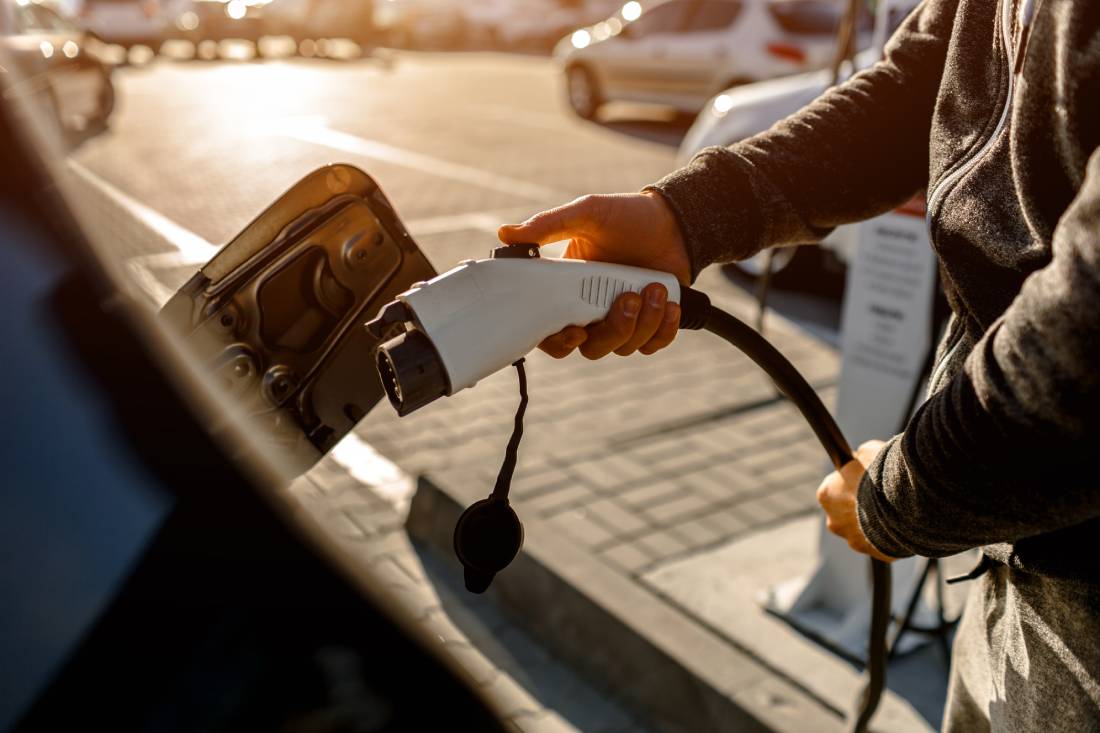
The term e-mobility describes the technical use of electricity to power vehicles as an alternative to the internal combustion engine. Since the transport sector is a major contributor to CO2 emissions, the transformation towards electromobility is considered an important pillar of decarbonisation. Particular challenges lie in the increasing demand for electricity and the creation of a sufficient charging infrastructure.
Overview of content
How does e-mobility work?
What challenges does e-mobility face?
What opportunities does e-mobility offer for the automotive industry?
How do companies influence the environment through the use of e-mobility?
How will the e-mobility sector develop in the next 5-10 years?
What new professions will be created by e-mobility?
How does e-mobility work?
E-mobility means that passenger and motor vehicles are powered by an electric motor that draws its energy from a rechargeable battery. This is a decisive difference to the electric drive in railways, which has been established for decades, where the electricity comes from overhead lines. In contrast, direct current is stored in the battery of the car, which is converted into alternating current by a so-called inverter (direct current to the alternating current converter) before the motor is driven. This drives the electric motor, generates magnetic fields, which in turn are converted into mechanical energy in the sense of rotary motion and finally enable the vehicle to be driven.
What challenges does e-mobility face?
The transformation to electromobility will lead to a significant increase in electricity demand. For example, in Germany alone, this would increase by 20 per cent of all passenger cars were converted to e-drives. To remain climate-friendly, the electricity would have to come from renewable energies, whose capacity is currently not even sufficient to cover the existing electricity demand. Another challenge is to create sufficient charging infrastructure and increase the range of e-cars. The duration of a charging process is also one of the challenges facing the electromobility sector. Even in the most favourable case, charging currently takes around 40 minutes, which is considerably longer than refuelling. The time factor can have a negative impact, especially on longer journeys that require recharging.
Furthermore, it is important to strengthen the image of electromobility and to establish it as a technically equal alternative to the combustion engine. In this context, reservations about the new technology must be dispelled, such as the rapid occurrence of battery fires or the unsuitability of electric cars for use in flooded areas. At the same time, the long-term advantages of electric mobility must be made clear.
What opportunities does e-mobility offer for the automotive industry?
One of the greatest advantages of electromobility is its high climate friendliness concerning the entire service life of the vehicles. Global CO2 emissions can be significantly reduced through the use of electromobility and climate change can thus be curbed. At the same time, the air quality improves, especially in congested inner cities, and the networking of different means of transport can also be optimised through the use of electromobility. Apart from the ecological component, the new technology can contribute to curbing dependence on fossil, finite energy sources, which increasingly serve as strategic leverage in international conflicts.
Finally, electromobility is a driver for innovative research and the expansion of various infrastructure projects (e.g. renewable energies).
How do companies influence the environment through the use of e-mobility?
Many companies have a more or less large fleet of company cars. If these are converted to e-vehicles, harmful emissions can be reduced and in this way, climate change can be counteracted by the economy. This is particularly true for companies in the transport sector, such as suppliers or freight forwarders.
How will the e-mobility sector develop in the next 5-10 years?
Numerous funding opportunities, better public relations and technical advancements (e.g. longer ranges) will mean that electromobility will continue to gain in attractiveness and importance over the next five to ten years. Globally, plug-in light vehicle sales were edging to reach a new records in sales, Europe being the largest driver of growth. Germany is the leading European market for electric car sales. Forecasts predict that by 2025 every fourth car in Germany will be powered entirely by electricity. As early as 2022, annual e-car production will be eight times higher than in 2019, at 600,000. In 2025, 1.1 million e-vehicles are expected to be produced in Germany each year. If experts' forecasts are correct, more e-cars will be registered in Germany from 2032 than internal combustion engines. The transformation is particularly dynamic in the micro and small car sector.
What new professions will be created by e-mobility?
New professions are emerging primarily in the classic engineering sciences of mechanical and electrical engineering, which are merging in the field of electromobility. Among other things, this has led to the development of the specialist engineer for electromobility. The first universities are now offering an "electromobility" degree programme. In addition, new professions have emerged in the development and construction of battery storage systems.
Classical professions such as automotive mechatronics, assembly, service or systems specialists are gaining a new area of specialisation with electromobility. The increasing demand for renewable energies is also creating new jobs such as electrical engineers for wind power, specialist for energy management or specialists for communal and decentralised energy infrastructure. The latter is significantly involved in the development of nationwide charging infrastructure.