
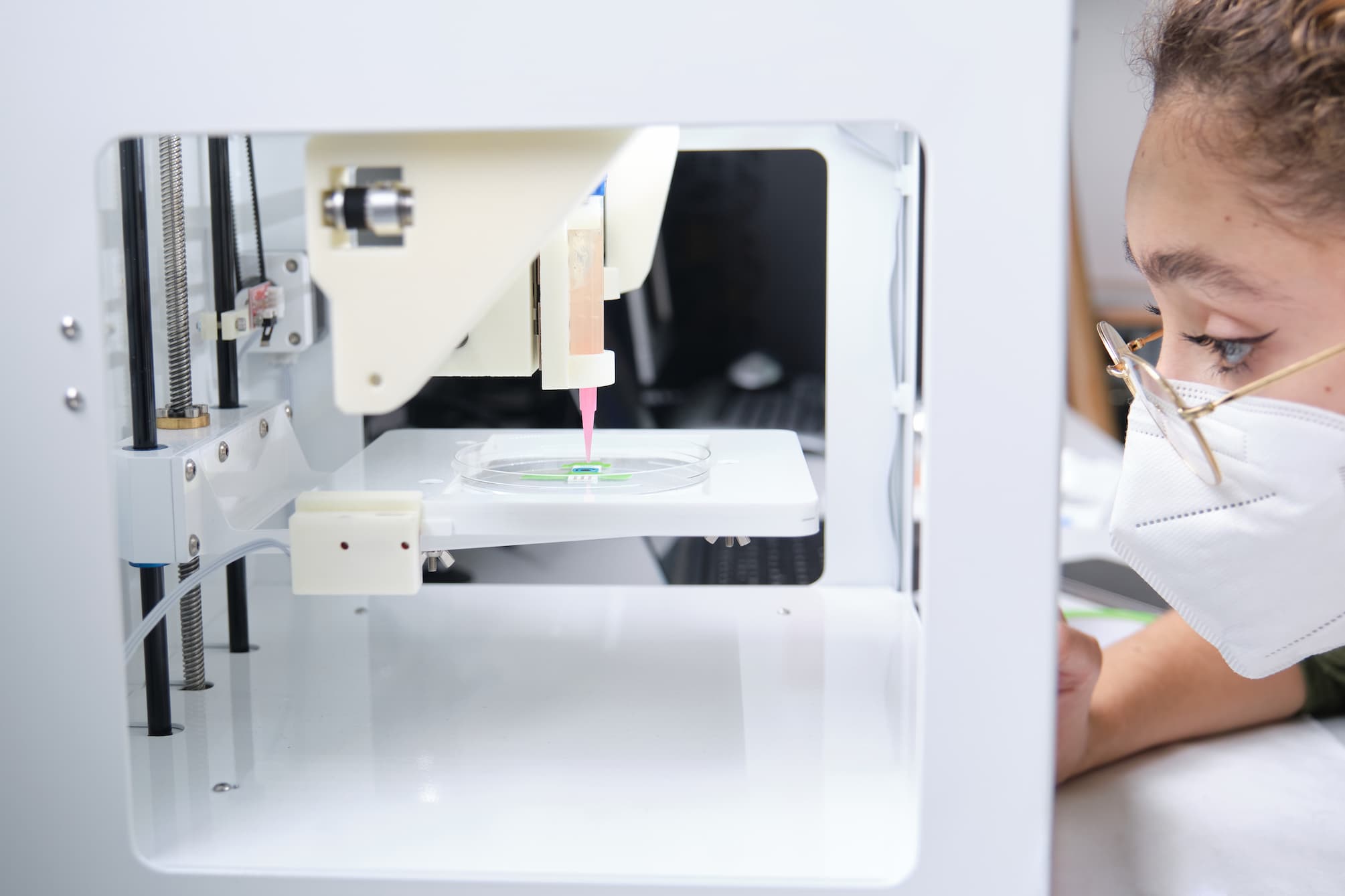
The term bioprinting describes a special form of 3D printing in which organic products are made. Well-known areas of application, some of which are still being tested, include medicine and the food industry. The pioneering goal of the medical sector is the layer-by-layer production of functional organs as a substitute for transplantation.
Table of contents
How does bioprinting work?
What does the detailed bioprinting process look like?
In what areas is bioprinting used?
What are the advantages of bioprinting for the medical industry?
What does the future hold for bioprinting?
What professions are involved in bioprinting?
How Brunel can support you in your next bioprinting project?
How does bioprinting work?
Bioprinting is based on the concept of producing three-dimensional objects layer by layer from organic substances. The principle is similar to traditional 3D printing, except that substances such as cell materials are used in place of traditional materials such as metal, plastic and polymer powder.
To produce a complex structure from basic organic materials, attention must be given to a whole series of parameters. For example, the temperature must not be too high, otherwise proteins will denature.
In somewhat simplified terms, the bioprinter is loaded with the "building materials", i.e. cells or the like, and uses them to build a complex, three-dimensional structure – such as a bodily organ – in accordance with a previously defined blueprint. As with industrial 3D printing, this is done through additive, layer-by-layer manufacturing.
What does the detailed bioprinting process look like?
"Construction planning" is the first step. This means that an exact scan of what is to be printed is made using imaging techniques. In the example of an organ, this would be an MRI scan, for example. A liquid is used to make other cellular structures transparent for better visualization. These structures are then scanned using a high-powered microscope and a laser scanner to create a highly accurate, three-dimensional computer model, which in turn serves as a blueprint for the subsequent printing process.
It is also necessary to multiply the cells of the target structure in a nutrient solution so that there is enough of the "building material" for the subsequent printing process. The cell material is then placed in a polymer gel. Layer by layer, the bioprinter then prints the cell-polymer mixture into the structure that was earlier defined as a model and fed into the printer as a template.
In what areas is bioprinting used?
The best-known examples are found in medicine, where researchers’ stated aim is to produce functional organs. Although the industry is not yet ready to produce functional body parts, prototypes have already been created through bioprinting. Back in 2019, scientists succeeded in printing a small human heart.
While joint implants from 3D printers have long been a reality, bioprinting could also herald a new era by producing prostheses from the body's own cells in the future.
Another area of application is the food industry. Also still in the experimental stage, researchers have already succeeded in printing meat from protein glue and muscle cells. Due to the immense costs, large-scale use is not yet possible. In the long term, however, bioprinting could make factory farming obsolete.
Biology also uses bioprinting for the production of and more precise research into tissues and organisms.
What are the advantages of bioprinting for the medical industry?
In the future, bioprinting will enable the medical industry to provide each patient with the highest level of individualized treatment. For example, a patient would receive an organ whose form fits him or her perfectly. In addition, blood vessels, muscles or other tissues could be manufactured with a perfect fit and implanted into the patient.
It would also be a tremendous advantage to be able to completely dispense with organ transplants in the future. Living organ donations, which are also associated with extensive and sometimes risky interventions, would be eliminated, as would the chronic undersupply of suitable donor organs. The problem of rejection reactions too is likely to become less important.
Bioprinting could even enable medical research to dispense with animal testing altogether. Effects on organ systems, for which tests on animals have had to be used up to now, could thus be tested specifically using printed structures. Bioprinting already plays an important role in clinical research. It was, for example, used in the development of the Russian COVID-19 vaccine Sputnik.
What does the future hold for bioprinting?
Few fields of research are predicted to have such huge potential as bioprinting. Basic research is being massively promoted precisely because the process could solve many of the problems of our day (such as animal testing, factory farming and the shortage of donor organs).
At the same time, the bioprinting industry will have to devote more attention to ethical issues going forward. As much as the world longs for a heart from the printer, the fear of the "printed human being" is just as pronounced. In summary, we can expect numerous groundbreaking developments in this industry.
What professions are involved in bioprinting?
Bioprinting combines biological and medical professions with engineering disciplines and information technology. Doctors and bioscientists are already working on the topic of bioprinting in collaboration with 3D printing experts and engineers. Because a bioprinter must be supplied with countless items of information, biomathematicians and bioinformaticians also play a crucial part in this topic.
Scientists working on tissue engineering possess one relevant core competence. The medicine of the future will probably rely increasingly on the artificial cultivation of tissues and the printing of complex structures.
In the future, professions are likely to emerge that do not even exist today. New medical specializations, separate courses of study in bioprinting and even new fields in imaging and information processing are conceivable.
How Brunel can support you in your next bioprinting project
Bioprinting is a complex field that requires collaboration with highly skilled professionals. A carefully assembled team of engineers, computer scientists and technicians can help you make your next bioprinting project a success.
Based on your precise needs, we will immediately begin the search for suitable candidates before advancing with you to the shortlisting process. Ultimately, a highly competent team will stand by you and actively support you in the extremely promising field of bioprinting!