
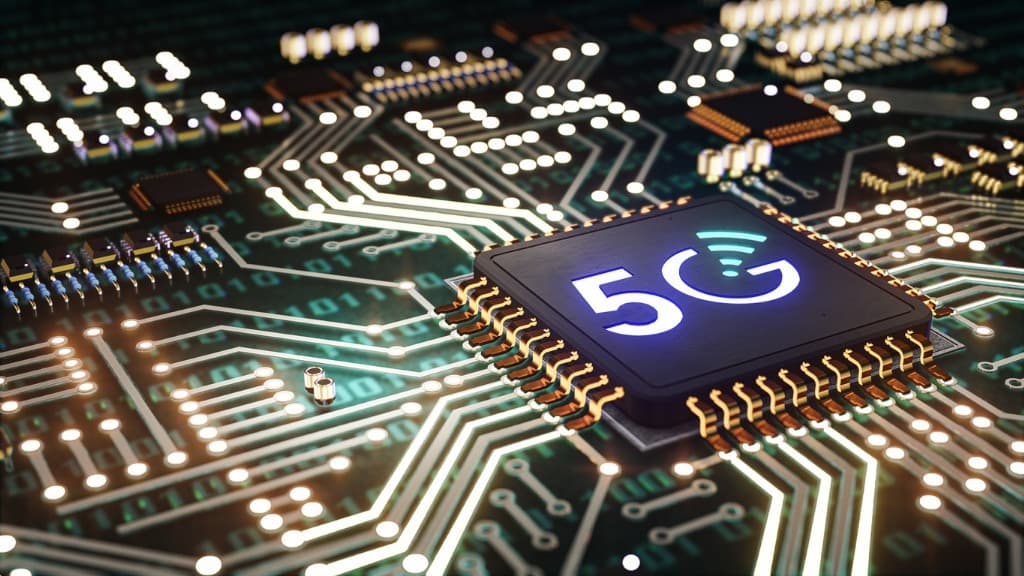
5G is the name given to the latest network and mobile communications standard, which features data transmission rates of up to 20 Gb/s, a frequency spectrum of up to 30 gigahertz and low energy requirements. 5G is the successor to LTE (4G) and is currently being rolled out in Germany.
Brunel helps you find the right 5G experts
Highly qualified, ready for flexible deployment and armed with in-depth industry-specific knowledge, our experts in telecommunication network, communications engineering and IT are consummate professionals. We guarantee made-to-measure solutions for your upcoming 5G project and work with you to chart the technological course for your company. Find out more about our experts and feel free to get in touch. Click here for more information on our temporary employment, work contract and service contract offerings.
Overview of content
What technology underpins 5G?
What opportunities will arise from the use of 5G technology?
What application areas/new technologies are there for 5G?
What conditions must be met to implement 5G?
How will 5G mobile technology be integrated in the corporate landscape?
What new job profiles will 5G create?
How Brunel can help you with your next 5G project
eHealth, robotic surgery, autonomous driving, smart farming: Applications such as these represent only a tiny fraction of what 5G will make possible in the future. For many industries, the fifth generation of mobile communications therefore not only means faster data transmission, but also brings with it revolutionary transformation. Find out why and discover what lies behind the new technology.
What technology underpins 5G?
Previous wireless networks rely on central data centers. With 5G, smaller EDGE servers are gaining in importance and facilitating far more tightly meshed networks. Shorter distances thus reduce signal latency. New antenna technology, including so-called bean-forming technology, is also being used. This involves arranging 128 tiny antennas in a very small space so that each of them always uses the best-placed air interface to transmit data to the user as quickly as possible.
The most crucial difference to LTE and all previous technologies is that the number of transmitter stations is now virtually independent of population density. As a result, the network architecture is based more on small cells, and more rooftop transmitters are being built, for example. The existing infrastructure will remain in place but will increasingly be upgraded – with fiber optics and new antennas, for instance. A single 5G transmitter can serve as many as a million terminals per square kilometer.
What opportunities will arise from the use of 5G technology?
All digital communication processes, including the transfer of large data packets, will be many times faster than with all previous network standards. In concrete terms, a 100-fold increase in transmission speed compared to LTE is possible. This means that companies can communicate virtually in real time – with all the benefits that yields for processes. Less downtime for equipment, lower power consumption and less wear and tear on equipment are further possibilities, although – especially at the beginning – these are associated with challenges of a financial and technical nature. Employees also require a proper introduction to the new technology and must be informed about the opportunities and challenges inherent in 5G.
What application areas/new technologies are there for 5G?
Headsets that translate your Chinese partner company’s presentation in real time. Fully automated forklifts that drive around the factory site and independently record what needs to be taken where. Such accomplishments require gigantic amounts of data – data volumes that no network has yet been able to transmit without disruption and on a long-term basis. For manufacturing, logistics and retail, transportation and traffic, the healthcare sector, agriculture and the energy sector, the new 5G technology thus opens up unimagined possibilities.
The Fourth Industrial Revolution: 5G technology harbors vast potential in relation to the Fourth Industrial Revolution. Connectivity between devices and machines and the increasing interchange of data between machines, plants, humans and robots requires a powerful and resilient network. The new 5G technology creates the conditions for this and enables real-time applications. Industrial robots can thus be controlled in real time and faults can be rectified more quickly. This is made possible by extremely low latency of less than one millisecond.
Healthcare sector: In the healthcare sector, the new 5G technology enables telemedicine applications, which in turn open up new opportunities for consumers as well as for hospitals and nursing staff. In the future, consumers themselves will use fitness trackers to send their vital data automatically and in real time to the attending physician. Critical values in patients can thus be detected much more quickly, which increases the chances of successful treatment. Hospitals, doctors and nursing staff will benefit from the new 5G technology by making remote diagnoses and even remote operations possible via video link in the future. The real-time monitoring of health data and the increasing connectivity of medical equipment will enable medical staff to intervene in serious situations in a faster and more focused manner, thus slashing high treatment costs at the same time.
Agriculture: Agriculture too will feel the impact of 5G, with "smart farming" becoming the new buzzword. The use of geopositioning systems, big data, the Internet of Things (IoT), drones and robotics is ushering in a precise and resource-efficient approach to more productive and sustainable agriculture. For example, weather data, soil conditions, fertilizing cycles and many other important pieces of information are collected to provide farmers with recommendations on how to manage their land most efficiently. And all these advances are dependent on powerful and fast data transmission.
Logistics: Efficient supply chains and low storage costs rank among the primary goals of logistics. 5G facilitates enhanced connectivity and real-time communication in warehouses and transshipment hubs and will thus contribute to smoother and faster delivery, as well as to lower storage costs. In the context of customs clearance, information on containers and their contents can be forwarded more quickly and reliably, resulting in lower storage costs on the part of companies. In addition, freight capacity can be better coordinated, while the use of autonomous (remotely controlled) driver assistance systems increases productivity in road traffic.
What conditions must be met to implement 5G?
The desire and need to use 5G even now, in the early stages, is the fundamental prerequisite for integration. A connection to the fiber-optic network is indispensable for the use of 5G. The issue of costs must be taken into account, as must the investment in devices that have to be compatible with the new standard. As with every technical advancement, demand for data security is also increasing. Hackers, too, will benefit from 5G and make their criminal transactions more professional. Lastly, this technical innovation must also be communicated adequately. Above all, widespread fears of health hazards from 5G must be dispelled on the basis of scientific findings and facts. Even if it is "only" a new network standard, it needs the backing of everyone.
How will 5G mobile technology be integrated in the corporate landscape?
The implementation process begins with a needs assessment. Although no company will be able to avoid the 5G network in the medium term, coverage is still low in some countries. Before a decision is made, the first question is therefore whether 5G should be introduced immediately. If so, management should communicate this to all levels of the organization. Information events for employees and workshops can optimally prepare the entire company. In collaboration with a professional network provider, it is important to work through a thorough checklist: Which technical requirements already exist for 5G at the company site? What aspects may need to be upgraded? If the company is located outside of the few regions covered by the 5G network to date, a 5G network license must be acquired. This will be followed by technical implementation of all necessary network devices and other devices.
What new job profiles will 5G create?
New opportunities for connectivity also generate new job profiles. Robot operators are becoming tele-surgeons who perform operations in real time over the network. Forwarders and forklift drivers are shifting their perspective and coordinating logistics from a monitor screen. Engineers and industrial workers are increasingly becoming robotics experts who program digital helpers to do their work for them. All this in turn requires people to develop new interfaces. New job profiles are also emerging in IT security, web development and app development, because 5G is opening up technical possibilities that are still off limits today due to restricted data traffic. This development will also give rise to further new job profiles in the area of augmented/virtual reality.
How Brunel can help you with your next 5G project
With Brunel by your side, your 5G project is in the best hands. Our experts have a knowledge and a wealth of experience in mobile communications technology, radio planning, radio frequency technology and radio frequency measurement technology. In addition, they are well versed in cloud-based applications, algorithm development, big data handling and IT security.
To find the perfect candidate for you, our account managers and talent scouts draw on various channels and networks. We also operate a proactive and forward-looking approach to candidates and benefit from a global network of technology and IT specialists. Get an insight into the knowledge and skills of our experts and find out more about our recruiting expertise.