
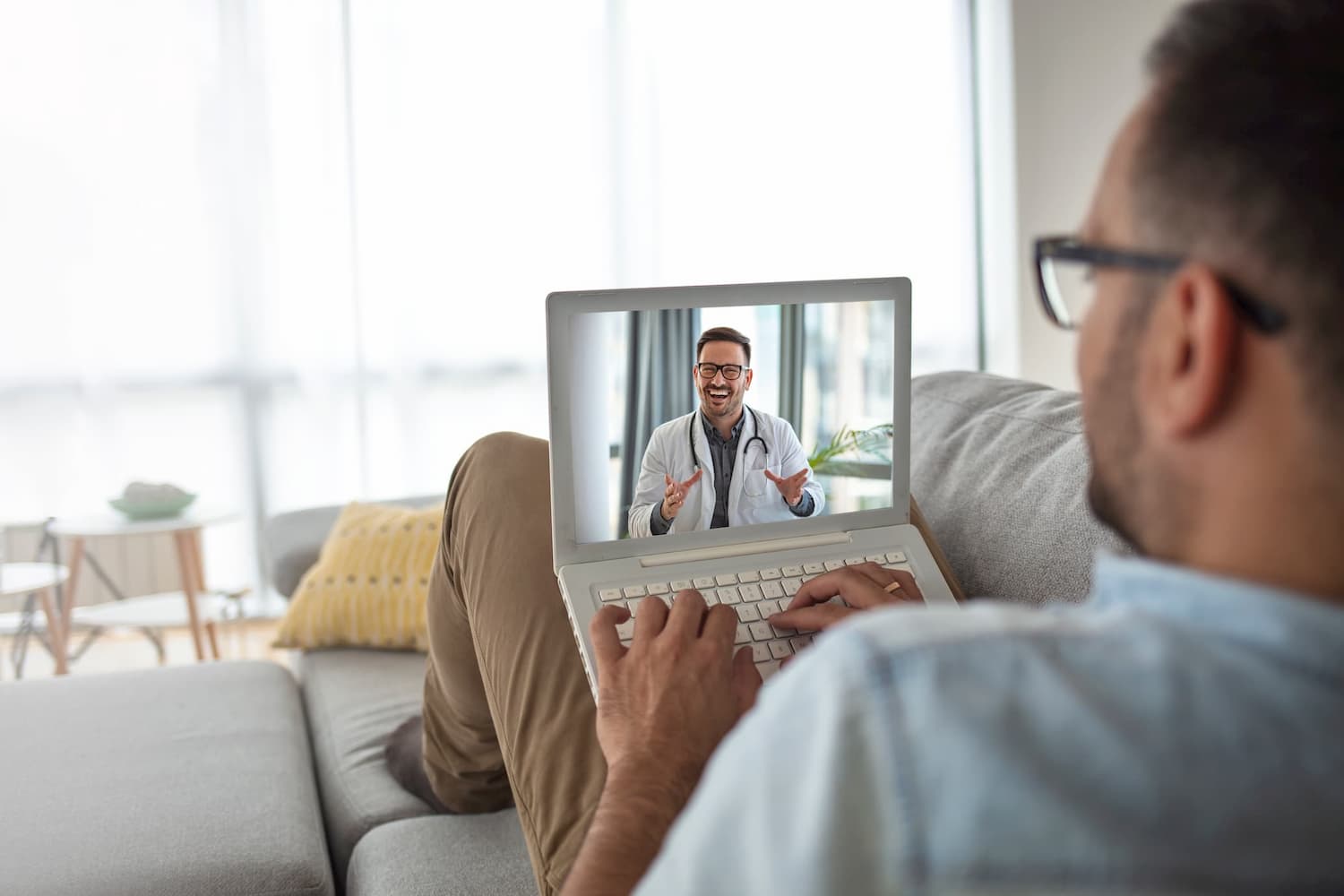
Telemedicine is a collective term for all medical services that take place without a physical meeting between a doctor and patient. The spatial distance is bridged by the use of telecommunications and information technologies. The term also covers the advancing digitization of medical-administrative processes. Although not yet widespread, the telemedicine concept is growing in importance and popularity. One example is the passing of Germany's Digital Supply Act (DVG) in 2019, laying the legal foundation for many telemedical applications in the country.
Find the right telemedicine specialists with Brunel
Your next telemedicine project is in good hands with Brunel. We can help you find candidates with the specialist knowledge, training, experience and soft skills needed to make your telemedicine project a success. Find out more about our services in recruitment and contracting & secondment.
Content overview
- What are the different types of telemedicine?
- What are the benefits of telemedicine?
- For which companies is telemedicine important?
- What are the areas of application for telemedicine?
- What challenges do companies face?
- What technical developments can we expect?
- What new professional fields will telemedicine create?
What are the different types of telemedicine?
When the term telemedicine is used, it's usually referring to a specific field of application, such as teleradiology, telesurgery or telediabetology. You can also differentiate telemedical services according to users: Doc-2-Patient and Doc-2-Doc. Doc-2-Patient services target the relationship between doctor and patient. Using a special device that the patient carries with him, the attending physician can remotely check the patient's levels in real time and, if necessary, initiate medical measures. The patient is thus in constant contact with the attending physician. Doc-2-Doc services, on the other hand, describe the transmission of patient data from doctor to doctor, e.g., to obtain a second medical opinion.
What are the benefits of telemedicine for companies and society?
Given the disparities in the distribution of medical practices between rural and urban regions, telemedicine offers an effective way for people in places with poor medical infrastructure to access quality medical care without having to travel long distances. In this way, the frequency of medical care can be increased, especially for people with limited mobility. The lack of a physical meeting can even be beneficial for sensitive issues and breakdown barriers. Medical parameters and scientific results can also be accessed, shared with colleagues and processed accordingly, regardless of location. For companies with technical expertise, telemedicine enables new research, development and production options that can last for decades.
For which companies is telemedicine important?
A distinction must be made here between developers, producers and users. Both private-sector developers and state research institutions are only at the beginning of an extensive research era to adapt telemedicine to the growing demands of the future (demographic change, increasing world population) and make it widely accessible. Manufacturers with information and electrical engineering expertise will grow in order to meet the growing demand. Above all, users such as medical practices, clinics, pharmacies and health insurance companies will face massive changes, as they must both create the technical infrastructure and also train and recruit personnel accordingly.
What are the areas of application for telemedicine?
The fields of application of telemedicine are fundamentally divided into the fields of telediagnostics, homecare and highly-specialized applications. In the field of telediagnostics, the attending physician can diagnose diseases without being physically present. One form of telediagnosis is, for example, teleradiology, in which X-ray, CT or ultrasound data are sent to special centers. There, experts examine the data on a teleradiology workstation and send the diagnosis back to the attending physician, who in turn addresses the patient. Another field of application for telediagnosis is telepathology. Using state-of-the-art microscopes, digital image data are evaluated in specialized centers and then sent back to the attending physician.
Tele-homecare or telemonitoring, on the other hand, means transmitting patient data, such as sugar or blood levels, from the patient to the attending physician using digital devices. This allows medical staff to access data such as blood sugar, heart rate or oxygen saturation in real time and initiate medical measures if necessary.
The implications reach further than healthcare: fields such as air travel and shipping can also benefit from highly-specialized telemedical services. Access to medical care in the sky or on the high seas can quickly become a problem. EKG data such as heart rate, blood pressure levels or body temperature can already be sent from an aircraft or ship to a ground station, enabling remote diagnoses and medical measures.
What challenges do companies face in order to offer telemedicine applications?
Companies that want to offer telemedicine applications face a crucial challenge, regardless of the technical investments: both employees and customers must be convinced that telemedicine will generate benefits for them. In healthcare in particular, stakeholders face two major concerns: the partial lack of physical meeting with the doctor could have a negative impact on diagnostic accuracy and thus the choice of therapy. Here, it is important to communicate to both employees and customers that telemedicine does not replace medical procedures, but only complements them.
The second concern relates to data protection, because after all, highly-sensitive data material is being used. Here, too, companies must convince stakeholders with clear concepts and plenty of information. Implementation can only succeed if both employees and customers are on board. In addition, all employees must be trained in the use of telemedicine applications.
Which technical developments will become more important in the next few years?
In addition to the further expansion of the telemedical communication infrastructure, the topic of artificial intelligence is likely to gain importance in the coming years. A well-known example of this are imaging procedures that use large amounts of data to make an initial tentative diagnosis based on the image produced. Telepresence robots are moving into the homes of patients in need of care. Patients and doctors will be able to connect via screens and wireless computer networks (WLANs), with swiveling optics enabling the doctor to view certain healing processes from a distance. Overall, networks will also gain importance, as will telemedical consultation for emergency medical care, where a specialist gives instructions to a care team at an accident site via direct connection. This is only a sliver of the possible developments in the coming years.
What new professional fields will telemedicine create?
In the area of research and development (R&D), new specialties in computer science and electrical engineering will undoubtedly emerge. Above all, though, the medical profession itself will change. While presence during diagnosis and therapy remains indispensable, the online or e-doctor, who exclusively provides digital advice, will gain more importance. The same goes for online pharmacists and digital health insurance advisors. Completely new professions can also be expected, including specialist professions (system architects, specialists, administrators) for digital health, specialized app developers and process consultants for e-health.
Need support for your next telemedicine project?
Your next telemedicine project is in good hands with Brunel. We can help you find candidates with the specialist knowledge, training, experience and soft skills needed to make your project a success.